
Dataset highlights
Selected images
Select an image to view the original
-
 Open original image in a new tab
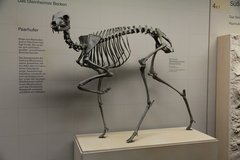
Präpariertes fossiles Skelett eines urzeitlichen Hirschs

About the collection
The collection
Size and focus of the collection: ca. 70.000 specimens (main focus on from sites in Baden-Württemberg)
Significance of the Collection: The Miocene finds of Steinheim a. Albuch, Langenau and Ulm are outstanding, important finds; in addition those from the Early Tertiary of Egypt (Fayum), the Isle of Wight (Great Britain) and the Badlands of the American West, the Late Tertiary of the Isle of Samos (Greece), and Peru.
Easy-language version
Fossil collection from the Tertiary period
The collection has about 70,000 specimens.
Most fossils come from sites in Baden-Württemberg.
Why is the collection important?
The collection includes important fossils from the Miocene period.
Important fossil sites in Baden-Württemberg are:
- Steinheim am Albuch,
- Langenau,
- Ulm.
The collection also includes fossils from other parts of the world:
- Egypt, from the Early Tertiary period, especially from Fayum,
- the Isle of Wight in Great Britain, from the Early Tertiary period,
- the Badlands region in the western United States, from the Early Tertiary period,
- the Greek island of Samos, from the Late Tertiary period,
- Peru.
Glossary
Early Tertiary
The Early Tertiary is an older name for an early part of a long period in Earth’s history. It came after the age of dinosaurs.
Fossil
A fossil is the preserved remain or trace of a plant or animal from the past.
Late Tertiary
The Late Tertiary is an older name for a later part of the Tertiary period.
Miocene
The Miocene was a period in Earth’s history. It lasted from about 23 to 5 million years ago.
Specimen
A specimen is one object, plant, or animal kept in a museum collection.
Background
Data project and service
The Ministry of Science, Research and the Arts Baden-Württemberg (opens in a new tab) supported inventory, digitisation and online access to the collections.
The data project “Fossile Mammals (Tertiary) at the Naturkundemuseum Stuttgart” and, unless stated otherwise, its supporting files are copyrighted © 2014– by the Staatliches Museum für Naturkunde Stuttgart.
Please note
Typing and other errors may occur. If you discover an error, please contact the editorial staff at the SMNS.